
The digital divide refers to gap between people who have affordable access and the skills, confidence and motivation to fully participate in the online world, compared to those who do not.
The online world is rapidly changing. With the rise of AI, device and app updates, and increasingly sophisticated scams, as well as cost of living pressures, not everyone is keeping up.
As part of Disability Pride Month, we have summarised the latest research on the state of digital inclusion for people with disability to help you understand this issue in more detail.
The Australian Bureau of Statistics tells us that 1 in 5 Australians have disability.1 This is a significant number of people that research tells us are more likely to be digitally excluded.2 The Australian Digital Inclusion Index indicates that people with disability have a digital inclusion score of 63.8 compared to the national average of 73.6.2 This applies across all indices, with people with disability being likely to struggle with access, ability and affordability.2 But, the good news is that levels of digital inclusion have improved over time and this divide has been closing.2
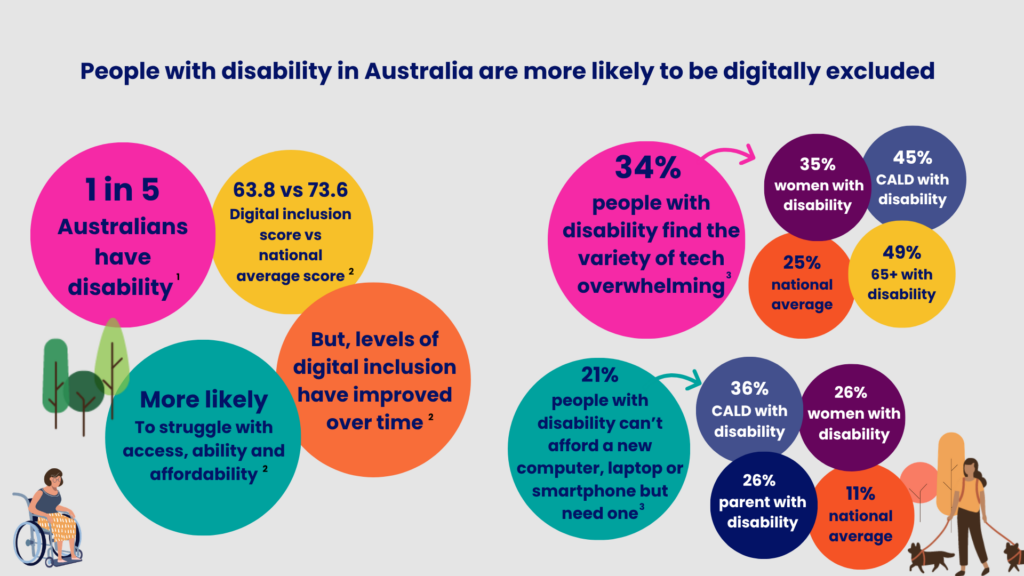
Good Things research indicates that some people with disability are more at risk than others of being left behind. While 34% of people with disability find the variety of tech overwhelming, already higher than the national average of 25%, this increases to 35% of women with disability, 45% of culturally and linguistically diverse (CALD) people with disability and 49% of people aged over 65 with disability.3
Likewise, 21% of people with disability say they can’t afford a new computer, laptop or smartphone but need one.3 This rises to 36% of CALD people with disability, 26% of parents with disability and 26% of women with disability.3 This compares to a much lower national average of 11%, showing the impacts of cost of living pressures and affordability.3
Australia’s emerging AI divide for people with disability
AI is playing an emerging role in the digital divide for people with disability. Attitudes toward using and learning about the new technology vary, overlaying skill, confidence, affordability and access barriers. Good Things’ research show that overall, 21% of people with disability, or one in five, are excited to learn about and use AI.3 Men with disability (29%), grandparents with disability (28%) and CALD people with disability (31%) are all more likely to be excited to learn about and use AI however, these rates are still al below the national average of 32%.3 Significantly less likely to be looking forward to the AI revolution are women with disability (16%) and parents with disability (11%).3
These findings broadly align with the Australian Digital Inclusion Indexes research that show a third of people with disability have used GenAI before, particularly for entertainment and advice purposes, but that this is a lower proportion of usage than the national average of 46% of people.2
Likewise, the Australian Digital Inclusion Index tests for essential AI literacy skills in it’s digital ability measures such as critical thinking, trustworthiness of information and data privacy. People with disability scored lower in these areas.2 In other research, people with disability report higher rates of concern when it comes to identifying some of the risks around generative AI. 35% of people with disability said they can’t tell GenAI content from real content, a higher rate than the national average of 29%.3
Together, this points to a concern that emerging technologies like AI may deepen the digital divide for people with disability, particularly around skills and confidence.
The online world is not equally accessible or safe
People with disability may face multiple barriers to digital inclusion that overlay to increase barriers to getting online.5 For example, a person may have disability and also be earning a lower incomes, or not be in the workforce seeing workplace connected digital skills development opportunities limited.
Online safety is an important area of concern for people with disability. Already, people with disability are more concerned scams are getting harder to spot compared to the Australian national average (54% vs 48%).3 This increased rate extends to families where the parents have disability. Further, while 34% of Australian parents of children are worried about their kids online, 38% of parents with disability have this same concern.3
Additionally, people with disability, are more likely to experience bullying, online hate speech, and tech based abuse than people without disability, pointing to an unequal online world as a starting point.4 Women with intellectual or cognitive disability and people with intellectual disability have been shown to be at particular risk in these areas.8
In terms of access, some apps, websites and content are not digitally accessible, even with assistive tech, which means some people may not be able to effectively use these technologies or communications platforms despite regulations in Australia requiring them to be so.4 People with disability are also less likely to have a good quality device5 and the affordability of being connected is a significant barrier, with a digital inclusion affordability score of just 57.2 compared to the national average score of 70.3.2
We can close the digital divide
What the research shows is that while progress has been made, there’s more to do to close the digital divide for people with disability so no one is left behind and ensure the online world is a safe and equal space for all. Essential online safety skills need to be maintained, support given to keep up with new tech like AI, and support offered to those most at risk of digital exclusion around affordability and access.
Further, people with disability need to be at the centre of solutions, actively contributing to the tech workforce, co-creating digital inclusion initiatives, and with cross-sector action to create an inclusive technology environment for all.
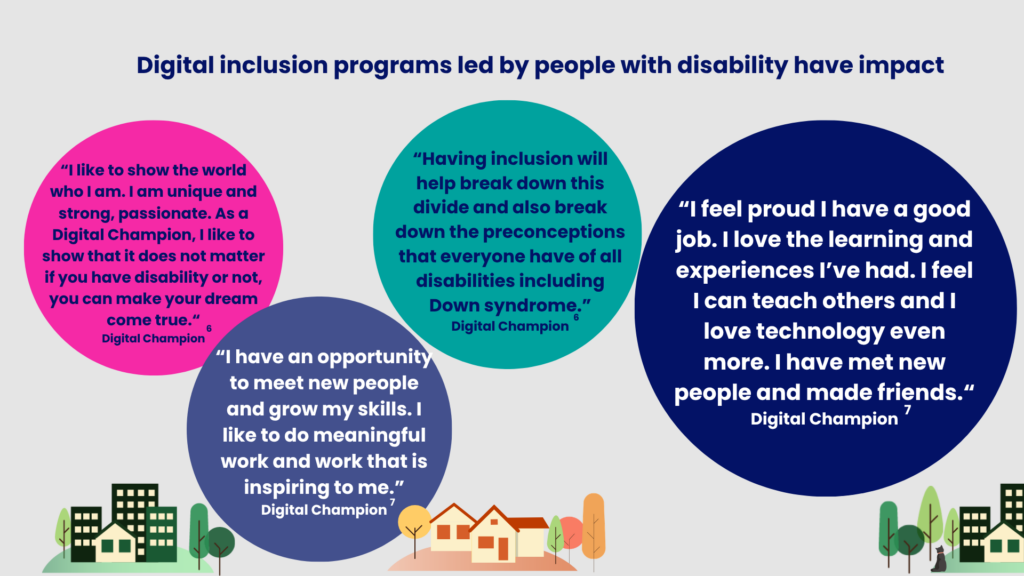
Digital inclusion programs led by people with disability have incredible impact on both those they are supporting and the people delivering the programs, empowering people to fully participate in digital Australia.
To close the digital divide, Good Things recommends that:
- Community led digital literacy programs are made available for all
- A national digital inclusion strategy is created
- Everyone has affordable access to the internet and devices
Disability Pride Month is a month of recognition, awareness raising and celebration of people with disability held in July every year.
References
- 5.5 million Australians have disability, ABS, 2024
- Measuring Australia’s Digital Divide: 2025 Australian Digital Inclusion Index, Thomas, J et al. 2025
- Australian Attitudes to Getting Online 2025, Good Things Australia, Good Things, 2025
- Protecting voices at risk online, eSafety Commissioner
- Digital exclusion in Australia – Evidence from the Household, Income and Labour Dynamics in Australia (HILDA) survey, Department of Infrastructure, Transport, Regional Development, Communications, Sport and the Arts ,2025
- Making Good Things happen at SXSW Sydney, Good Things, 2025
- Digital Champions, Good Things 2025
- How adults with intellectual disability experience online abuse, eSafety, 2022; Technology-facilitated abuse of women with intellectual or cognitive disability, eSafety, 2021
Published: July 2026