
The ‘digital gender divide’ refers to women and girls having less access to, and participation in, the online world compared to men.
The online world is rapidly changing. With the rise of AI, device and app updates, and increasingly sophisticated scams, not everyone is keeping up.
This week as part of International Women’s Day, we have summarised the latest research on the state of digital inclusion for women to help you understand this issue in more detail.
The global context
Globally, there is a clear digital gender divide. Across the world, just 65% women are online compared to 70% men – the gap being more pronounced in developing countries. There have been some improvements in recent years in terms of connectivity, with the gender divide in mobile phone ownership narrowing to 7% from above 9%.1
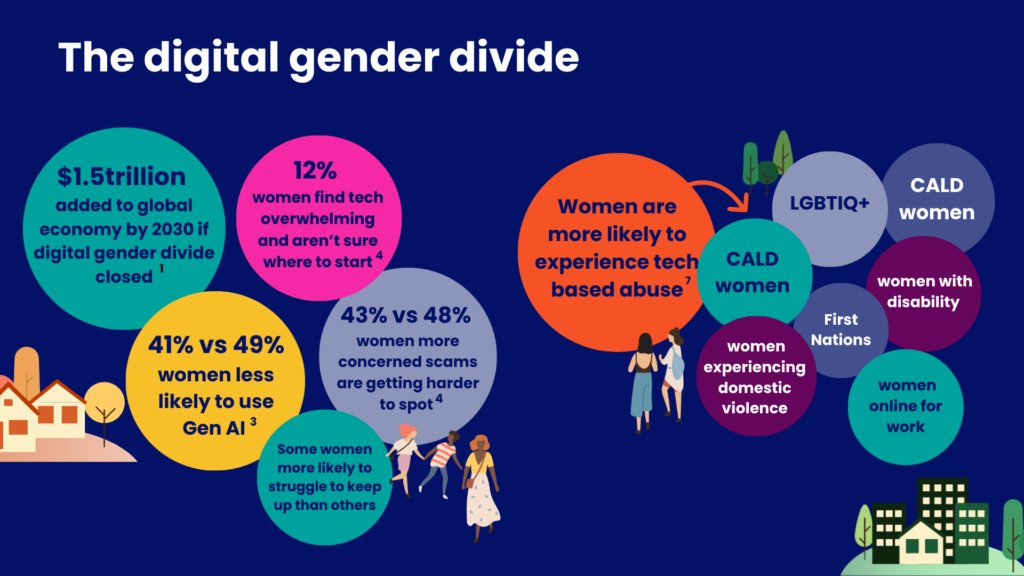
The changing tech landscape is impacting women and girls at significant rates. Women in work are more likely to be impacted from the rise of AI. 28% of women’s jobs are exposed to and at risk from generative AI (GenAI) compared to 21% of men.1 Further, 85% of connected women around the world have witnessed online violence against other women, pointing to important safety concerns.2
In positive news, $1.5trillion could be added to global economy by 2030 if the digital gender divide closed, with hundreds of millions of women and girls impacted.1
Australia is less at risk but gaps still exist
Comparatively, the digital gender divide in Australia is less pronounced than in other countries, but important gaps do still exist.
Digital inclusion research shows that overall women are not much more digitally excluded than men in Australia.3
However, it is concerning that some women are more likely to struggle to keep up with rapid tech changes, particularly those already facing barriers to equal participation in work, learning and community life.
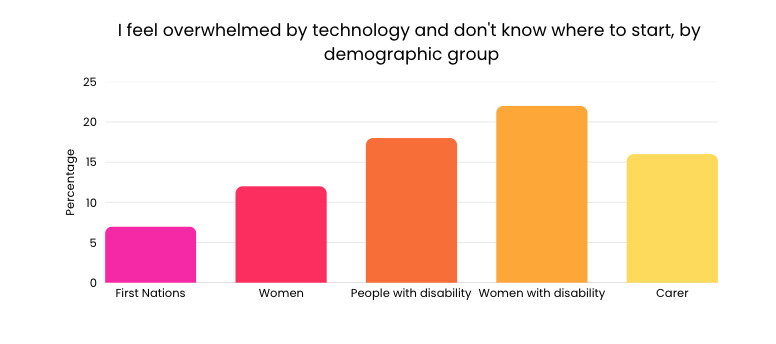
12% of women said they feel overwhelmed by technology and are unsure where to begin, compared to 10% of men. This rises to around one in five women with disability (22%) and culturally and linguistically diverse (CALD) women (18%).4
The same research shows that one in three CALD women find the variety of technology overwhelming (36%) compared to just one in five CALD men (22%) and 27% of that same group of women said they need help to keep up with rapid tech changes. Culturally and linguistically diverse young women are also twice as likely to struggle with unreliable internet connectivity than the general population.4
There are also differences in how Australian women versus Australian men use digital tools, such as for creative purposes or connecting with others.5
Australia’s digital gender AI divide
One area where there is particular concern both in Australia and globally is use and uptake of AI.
In 2024, it was found that men were significantly more likely than women to have used both text and image based GenAI .5 This research also found that women were also more likely to not know what GenAI is compared to men (43% women vs 32% men).
By 2025, the Australian Digital Inclusion Index found that while overall usage of GenAI had grown, a gender divide remained with 49% of men having used GenAI in the past 6 months, compared to 41% of women.3
This is backed up by Good Things’s own consumer research data. 29% of Australian adults say they struggle to tell AI generated content from real, rising to 33% of women, 39% of mums, 49% of grandmas, 40% of women with disability and 35% of CALD women – all higher rates than their male counterparts.4
Women are also less likely to ask AI for help when something goes wrong than men, with this even more pronounced for mums and grandmothers.4 While mums, grandmothers and CALD women are more likely to struggle with using AI tools then the general population, and more so than women in general, this is not too dissimilar from men with the same demographics.4
Significantly, women are less represented in the AI and technology workforce, meaning they are playing less of an active role in tool design and decision making as well as potentially missing out on jobs in economic growth areas.6
It’s not just AI that is causing concern for Australian women
Online safety for Australian women is a second area of concern. While 48% of Australians are concerned that scams are getting harder to spot, this rises to 53% of women. More than half of CALD women are worried that scams are becoming harder to spot (54%).4 Mums are more worried than dads about how their kids are using technology and if they are safe online.4
Women are more likely to experience tech based abuse than men, including coercion, bullying and sexual harassment, over a longer period of time and with higher impacts on their lives.7 Women are twice as likely to fear for their safety compared to men as a result of tech-facilitated abuse (26% vs 13%).7
The eSafety Commissioner notes that this tech-based abuse affects women from all walks of life and in all of their diversity, including transgender women.7 But, some women are more likely to experience it than others, such as women with an online presence for work, who are experiencing domestic violence, First Nations women, CALD women, women with disability, or who identify as LGBTIQ+.7
Women are also more likely to experience gender based online hate, at 23% compared to 17% of men, while men were more likely to report experiencing other types of online hate at higher rates than women.8
While also offering some solutions, AI has been shown to be increasing the rate and intensity of tech-facilitated abuse, which disproportionately impacts women.2
We can close the digital divide
While gender alone does not determine the digital divide in Australia, it is an important factor globally and for some areas of concern in Australia, including online safety and use of emerging technology like GenAI.
What the research shows is that there’s more to do to close the digital divide so no one is left behind and ensure the online world is a safe space for all. Essential online safety skills need to be maintained, support given to keep up with new tech, particularly for those in workplaces or with families, and support offered to those most at risk of digital exclusion and with online safety concerns. Further, women need to be at the heart of the solutions, actively contributing to the STEM and AI workforce, and cross-sector action is needed to create an inclusive technology environment for all.
Community based digital skills programs is one of the ways support for women most at risk of being left behind can be delivered, and has proven to help people feel safer online and keep up with tech. 88% of people in Good Things’ Digital Sisters program for migrant and refugee women have increased their digital skills in one or more areas. 71% improved their online safety skills and 83% increased their knowledge of AI.9
To close the digital divide, Good Things recommends that:
- Community led digital literacy programs are made available for all
- A national digital inclusion strategy is created
- Everyone has affordable access to the internet and devices
International Women’s Day is a global day of action and celebration of women held on 8th March every year.
References
- Progress on Sustainable Development Goals, UN Women, 2025
- How AI is exacerbating technology-facilitated violence against women and girls, UN Women, 2025
- Measuring Australia’s Digital Divide: 2025 Australian Digital Inclusion Index, Thomas, J et al. 2025
- Australian Attitudes to Getting Online 2025, Good Things Australia, Good Things, 2025
- Adult Media Literacy in 2024: Australian Attitudes, Experiences & Needs, Notley et al, 2024
- UNESCO Women for Ethical AI: Outlook Study on Artificial Intelligence and Gender, UNESCO, 2024
- Online risks for women, eSafety Commissioner, 2026
- Fighting the Tide, eSafety Commissioner, 2025
- Digital Sisters Digital Skills Checkers, Good Things, 2026
Learn more
Find out more Good Things we do: