
The online world is rapidly changing. With the rise of AI, device and app updates, and increasingly sophisticated scams, not everyone is keeping up.
Online safety is an essential digital skill and an important part of the overall digital inclusion picture.
This week as part of Safer Internet Day, we have summarised the latest research on digital inclusion and online safety to help you understand the relationship in more detail.
Not everyone is confident and safe online
The recent Australian Digital Inclusion Index found that while the digital divide has narrowed, 1 in 5 Australians remain digitally excluded, with 1 in 10 highly excluded.1 Adding on to that, Good Things research with 2,000 adults found that 1 in 10 find tech overwhelming and aren’t sure where to start.2
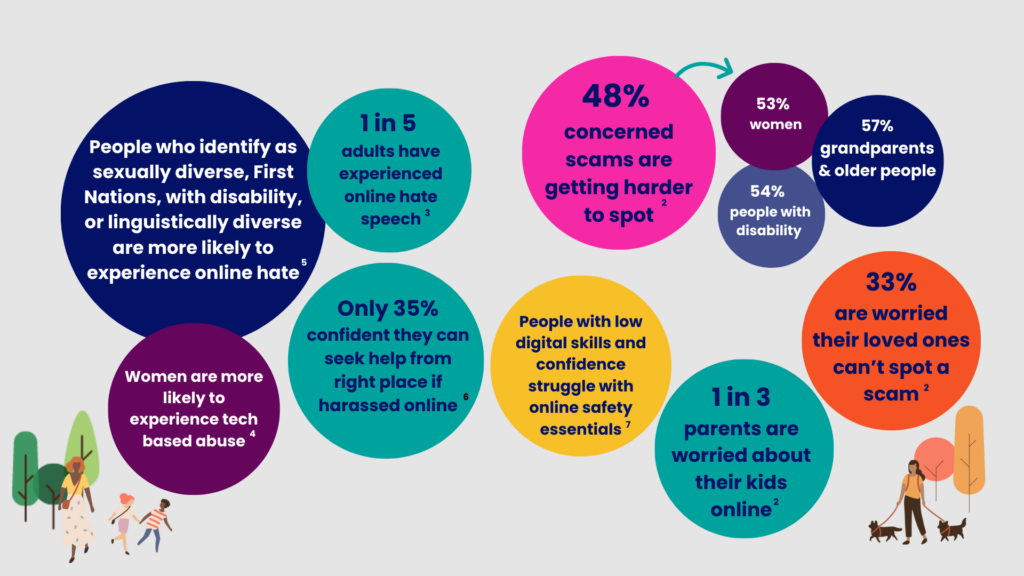
Many are concerned about online safety, and this can stop them doing more or being confident online. 48% of Australians are concerned that scams are getting harder to spot.2 This rises to 53% of women, 54% of people with disability, and 57% of grandparents and older people.2
These concerns about online safety often extend to those close to us in our lives. 33% are worried their loved ones can’t spot a scam, and 1 in 3 parents are worried about their kids use of technology and online safety.2
Apart from these concerns, some people are less safe online than others. 1 in 5 adults have experienced online hate speech.3 People who identify as sexually diverse, First Nations people, people with disability, or who are linguistically diverse have been found to be more likely to experience online hate.5 Further, women are more likely to experience tech based abuse than men, including coercion, bullying and sexual harassment.4
Concerningly, only 35% of people are confident that they can seek help from the right place or authority if they are harassed online.6
And, people with low digital skills and confidence struggle with online safety essentials.7 This points to a critical gap in online safety skills and attitudes in the Australian community.
The online world changes quickly, and safety skills need to be kept up
With rapid changes in the digital world happening around us, online safety skills and knowledge need to be continually worked on to stay up to date. For example, 29% of Australian adults say they struggle to tell AI-generated content from real, rising to 33% of women and 41% of over 65’s.2
Positively, there is significant appetite to learn these skills. 60% want to learn more about protecting themselves from scams and predators, and 1 in 2 want to learn more about finding reliable info online.6
A massive 82% of people want media literacy programs for adults, which incorporate these important safety skillsets.6
Community based digital skills programs is one of the ways this support can be delivered, and has proven to help people feel safer online. 66% of learners in Good Things’ Be Connected digital skills program for over 50’s have improved their management of privacy and personal info online, and 65% improved their ability to avoid scams and unwanted spam.7 Additionally, 85% of people in the program want to keep learning essential digital skills like these.
We can close the digital divide
What the research shows is that there’s more to do to close the digital divide so no one is left behind and ensure the online world is a safe space for all. Essential online safety skills need to be maintained, and support offered to those most at risk of digital exclusion and with online safety concerns.
To close the digital divide, Good Things recommends that:
- Community led digital literacy programs are made available for all
- A national digital inclusion strategy is created
- Everyone has affordable access to the internet and devices
See how you can take part in Safer Internet Day in your community, using free resources.
Safer Internet Day is a global day of action, led in Australia by our friends at eSafety.
References
Research sources:
- Measuring Australia’s Digital Divide: 2025 Australian Digital Inclusion Index, Thomas, J et al. 2025
- Australian Attitudes to Getting Online 2025, Good Things Australia, Good Things, 2025
- Hate in the Digital Age, eSafety Commissioner, 2025
- Online risks for women, eSafety Commissioner, 2026
- Fighting the Tide, eSafety Commissioner, 2025
- Adult Media Literacy in 2024: Australian Attitudes, Experiences & Needs, Notley et al, 2024
- Be Connected Digital Skills Checkers, Good Things, 2026