
Good Things Australia’s latest research highlights Australian attitudes towards getting online in 2026.
With the rapid emergence of new technologies and ongoing cost of living crisis, this report presents the findings of a national survey of two thousand everyday Australians exploring how people are navigating rapid technological change, AI, online safety and the cost and pressure of keeping up.
The cost and pressure of keeping up
As the digital world rapidly changes, everyday Australians and businesses are facing the challenge of keeping up with tech. This has various costs, both financial and personal, that overlay existing affordability barriers within the digital divide.
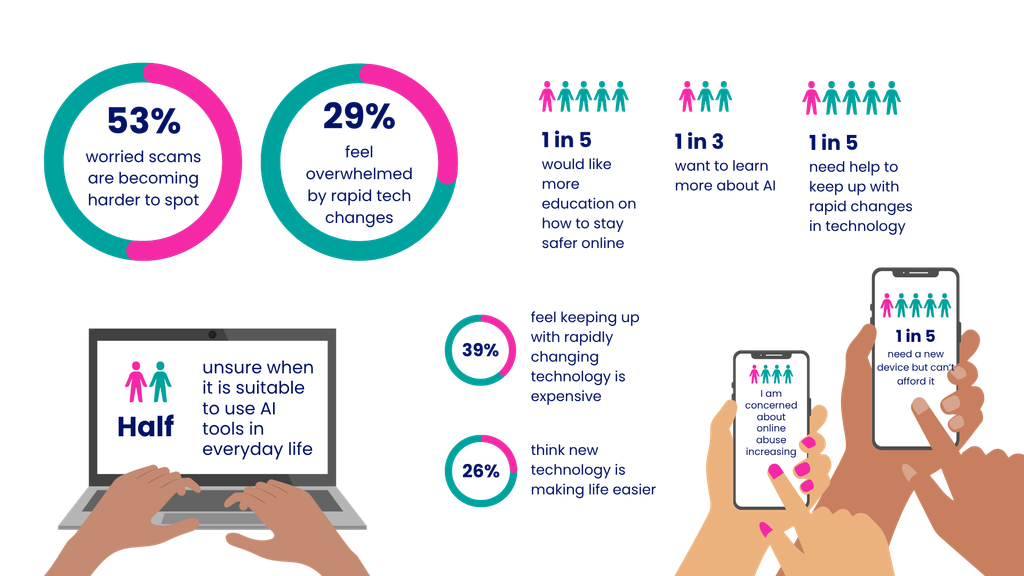
Responses to the survey show that levels of device based affordability stress have increased in the past year. In 2025, one in ten said they could not afford a new computer, laptop, or smartphone but needed one. In 2026 this has risen to nearly one in five (18%) people.
Beyond the affordability of physical devices, the 2026 survey showed that one in ten people are struggling to afford their internet or phone plan, with women slightly more likely than men to select this option, as were people who are unable to work, First Nations people, people who finished Year 10 or below, carers, and people with disability. Further, nearly one in three people said they are cutting back on subscriptions to paid online services because they are struggling to afford them.
Overall, two in five people agreed that keeping up with rapidly changing technology is expensive, indicating that this is a key concern for many people across the country.
Beyond financial pressures, participants were asked how they feel changing technology impacts their life. More than one in four Australians said they feel overwhelmed by rapid changes in technology, rising to one in three women, and nearly half of women with disability. Similarly, one in five people said they can’t keep up with constant tech changes, and the same number agreed that they need support to do this.
Attitudes to online safety
Online safety remains a critical concern. The research showed that 53% of people are worried scams are becoming harder to spot. For comparison, this has increased since 2025, where 48% of people had this same concern.
For the first time, the survey asked if people are concerned that what they see online is impacting them negatively. Overall, nearly one in five people agreed with this statement, with younger adults much more likely to have this concern than older populations. One in four agreed that they are worried about their children or family’s safety online, with the same proportion concerned about online abuse increasing.
Across three key online safety skill areas including finding reliable information online and avoiding scams, the findings showed that men were more confident staying safe online than women. Significantly, one in five people agreed that they would like more education on how to stay safer online, showing positive interest in actively improving online safety skills.
Attitudes to AI
Many are concerned about AI and have low confidence using it appropriately. The research shows that just 27% of people are confident using AI and only 12% feel confident supporting others to use AI. Further, half are unsure when it is suitable to use AI tools in everyday life, with significant variances in responses across age groups.
With the additional presence of AI in national conversations, people were asked if they are worried about the impacts of AI on society and our environment. 39% of people had this sentiment, which was particularly evident in over 65s, people with disability, and women – particularly young women, culturally and linguistically diverse women, mums and grandmothers.
More than one in three people said that they want to learn more about AI. Within that group, people were most interested in learning about using AI apps and tools, AI and online safety, and AI prompting.
Key findings
Now in its fourth year, the research continues to provide actionable insights into Australian consumer attitudes, skills and needs, uncovering trends across the country and highlighting opportunities for action to close the digital divide so no one is left behind. The 2026 findings show that people of all ages are affected by different aspects of digital exclusion, from skills and confidence to affordability and access, while some demographic groups face greater barriers or pressure than others.
Download the full report to read more detail about the research, including information on communities more at risk of being left behind.
This PDF was produced to be accessible. Please contact Good Things if you need an alternate format of this report.